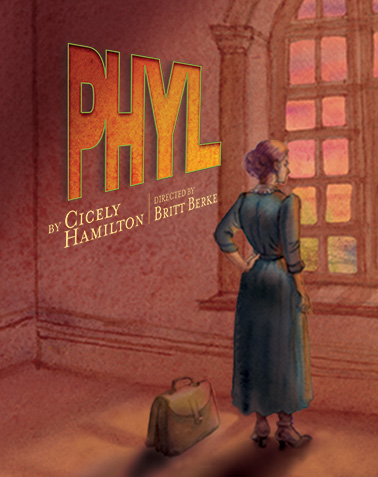
PHYL is the story of Phyllis Chester, a passionate, feisty young woman desperate to break through the barriers that confine her, eager to find excitement, pleasure and happiness.
Phyl works as a governess for a pair of cheeky sisters who take delight in tormenting her. She is ‘not good enough for the dining room, but a little too good for the kitchen.’ She spends her days with the spoiled children and her evenings alone.
“I’m shut away from men in my own station of life—whatever that may be—as I’m shut away from everyone else. That’s what I’m paid for—to be shut away. I look on and see other people happy—and, O God! I do so want to be happy myself…”
The girls provoke Phyl into losing her temper—it isn’t very hard—and after an explosive scene with their mother in which Phyl loses her temper again and speaks her mind, she ends up getting the sack. Has Phyl finally hit rock bottom, or is she on the brink of a new world of adventures? Or both?
What follows are opportunities and temptations forbidden to girls who must support themselves, but Phyl says, “I’d just as soon be looked down upon for being wicked as be looked down upon for being poor.”
PHYL was set to premiere at Oxford in 1913, but the performance was forbidden. The Times reported, “A little stir has been caused by the severely censorious attack of the Vice Chancellor of Oxford University toward the latest play arranged for production at Oxford.” The author explained that “PHYL has passed the Lord Chamberlain, who did not require the alteration of a single line, but the Vice Chancellor appears to possess a kind of medieval power in these matters…you may make fun of a departure from conventional ideas, but apparently you are not allowed to treat it seriously.” Miss Hamilton does admit in her own dry way that the play is a comedy “because it has a happy ending, and I hope somebody is funny in it.”
PHYL went to Brighton for its premiere instead, where “a large audience received the performance with every sign of admiration.” Thereafter newspapers featured the word BANNED in nearly every headline, as the production travelled from Brighton, to Edinburgh, to Manchester in 1913, and to Chicago in 1914. PHYL was never published.
Fortunately, the Lord Chamberlain’s office kept a copy of every play submitted for approval, now held at the British Library—and that’s where we found it.
Cicely Hamilton (1872-1952) was an actor, an author and a crusader for women’s rights who believed that true progress requires recognizing woman “as a responsible human being with an individuality and interests of her own.” She wrote several plays tackling social issues. But it was DIANA OF DOBSON’S that caught London’s eye and heart with its light touch and romantic bent in spite of its consideration of ‘serious issues.’ First performed in London in 1908, the play was “accepted as a true picture of the shop-assistant’s life,” to quote from a 1908 press clipping that, “convinced people that something should be done about it.”
During World War I she helped to establish an Auxiliary Hospital in France where she nursed wounded soldiers. She later joined the Women’s Auxiliary Corps and was assigned to a postal unit. Eventually she formed a repertory company that performed plays for Allied soldiers on the Western Front. After the War, Hamilton worked as a freelance journalist and was a regular contributor to feminist journal Time and Tide. Hamilton wrote over half a dozen novels including Besides William – An Englishman (1919), Theodore Savage (1922) and Full Stop (1931), as well as twenty plays, of which Diana of Dobson’s is the best known. She died in 1952.
Hamilton was a member of the Women Writers’ Suffrage League, a founding member of the Actresses’ Franchise League, and was one of the first members of the Scottish Women’s Hospital Committee.
Hamilton’s works include the plays, HOW THE VOTE WAS WON and A PAGEANT OF GREAT WOMEN, and her influential book MARRIAGE AS A TRADE. Her autobiography, published in 1935, is entitled LIFE ERRANT.
MEET THE TEAM: Britt Berke and the designers.
Sunday October 4, after the matinee
Director Britt Berke and her design team will talk about creating the world of the play and take your questions.
ANNA ANDES, SUSQUEHANNA UNIVERSITY
Sunday October 18th, after the matinee
Anna Andes is an Associate Professor of Theatre and coordinator of the Women and Gender Studies program at Susquehanna University. Her scholarship is focused upon suffrage era, British and American women playwrights. Her publications include essays with particular focus upon the plays of Cicely Hamilton, Elizabeth Robins, and Rachel Crothers. Also a director, her production credits include Hamilton’s Diana of Dobsons, Robins’ Alan’s Wife, Susan Glaspell’s Trifles, The Outside and Chains of Dew and Rebecca Lenkiewicz’s twenty-first century suffrage drama, Her Naked Skin. In 2020 she co-authored her own twenty-first century suffrage drama Pageant of Agitating Women (inspired by Hamilton’s Pageant of Great Women) with Monica Prince. She is currently writing a monograph on the plays and novels of Cicely Hamilton.
J. ELLEN GAINOR, CORNELL UNIVERSITY
Saturday October 24, after the matinee
J. Ellen Gainor is a specialist in British and American drama of the nineteenth and twentieth centuries and women’s dramaturgy and the author of the award-winning studies Shaw’s Daughters: Dramatic and Narrative Constructions of Gender and Susan Glaspell in Context: American Theater, Culture and Politics 1915-48.