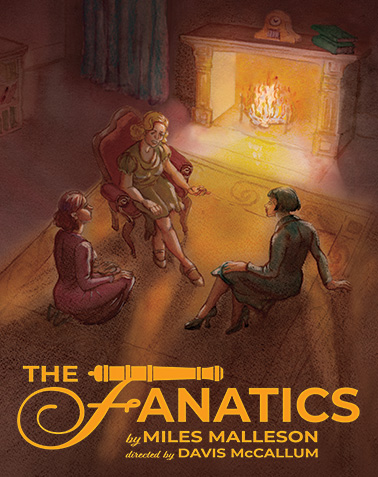
John Freeman and his sister Gwen, disillusioned by the Great War—are each trying to forge lives based on radical new ideas about love, sex and marriage—while living under their parents’ roof.
THE FANATICS is the third Malleson play produced by the Mint. First came the world-premiere of YOURS UNFAITHFULLY, an “un-romantic comedy” about the price of free love in 2017, and in 2018, CONFLICT, about political rivals in love with the same woman. “Both plays argue for Malleson as a playwright of insight, wit and compassion. He is also a writer who takes sex seriously. And it never occurs to him to punish his characters for wanting it and having it. That gets my vote,” declared Alexis Soloski in the Times.
THE FANATICS was Malleson’s most successful play. It was published in 1924, and after much wrangling with the censor, finally produced in 1927 in a version in which “several extensive cuts were made” (as described in a later edition of the author’s preferred version.) Although THE FANATICS is filled with wit and humor, it is also fueled by post-war rage and predicts the next war.
Miles Malleson (1888-1969) established himself as a theatre artist of dazzling versatility, as a playwright, screenwriter, director, producer, and character actor. Yet while Malleson “acted the fool most memorably” in dozens of plays and films, he was also a playwright of provocative wit, searching insight and, as described by The Manchester Guardian, a sense of “ethical passion” drawing upon a lifelong engagement in progressive politics.
Born on May 25, 1888, in South Croydon, Surrey, William Miles Malleson enjoyed an idyllic, middle-class childhood in Brighton. However, family holidays spent at his Uncle Philip’s “passionately puritanical” Great Tew vicarage fueled Malleson’s rebellion against Victorian values. In 1908, Malleson entered Emmanuel College at Cambridge, where he excelled in the Amateur Dramatic Club. A wildly successful practical joke—the impersonation of a conservative MP at Cambridge—set Malleson’s mind upon the professional stage. At Herbert Beerbohm Tree’s Academy, Malleson gained acting experience and wrote short plays. He soon eloped with the brilliant Lady Constance Annesley, an actress, writer, and rebel daughter of an Irish earl.
During the World War I years, Malleson blended political activism with his rising career in the theatre. Both Miles and Constance moved among bohemian circles, joining movements in socialism, women’s suffrage, and causes of free love. They also became involved with the pacifist No-Conscription Fellowship, following Malleson’s military service. Invalided from the army in January 1915, after serving briefly in Malta with the City of London Fusiliers, Malleson confronted the horror of a “world gone mad” in his one-act plays, ‘D’ COMPANY and BLACK ‘ELL. In October of 1916, the British government seized copies of both plays from the publisher and denounced them as “a deliberate calumny on the British solider.”
Throughout the 1920s, Malleson led parallel lives as a classical actor and modern playwright. His political comedies, including CONFLICT (1925) and THE FANATICS (1927), balanced the playwright’s commitment to social reform with sparkling dialogue and nuanced craftsmanship. Of FOUR PEOPLE (1928), The Guardian praised “the play of a mind which is at war with usage and with institutions…and which can accept no sanctity of a social routine unless it justifies itself in human values.” At the same time, Malleson’s renown as “the best Shakespearean clown in the contemporary English theatre” (as described by St. John Ervine) led to roles in over a hundred films (including Kind Hearts and Coronets), as well as a distinguished career as a screenwriter. Also famous for his prose adaptations of Molière, Malleson died at the age of eighty on March 15, 1969. (Written by Maya Cantu)